
Between Death and Life

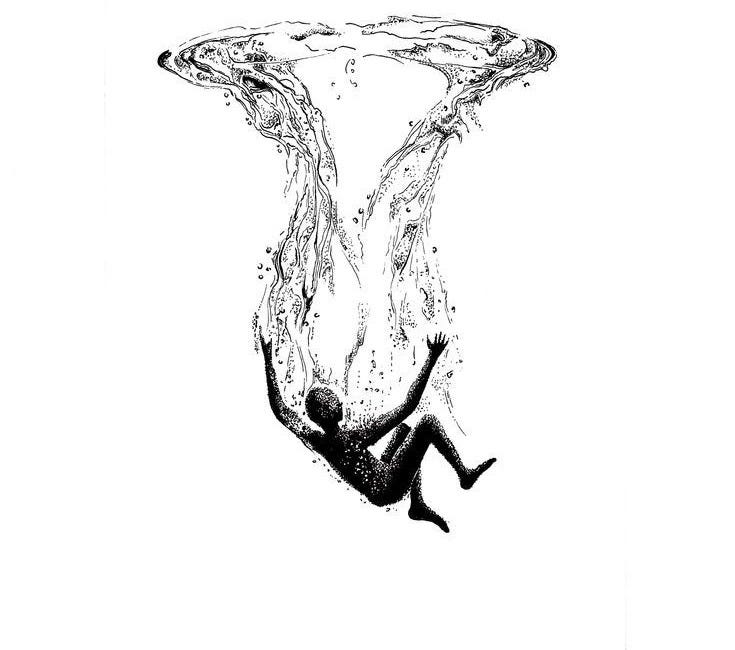
The Thing We Cannot Enter
There is a conversation we have been having for as long as we have been human, and it is not really a conversation because only one side speaks. The living. We talk about death constantly. We build entire civilizations around it. We erect monuments to it, compose liturgies for it, write philosophies that either make peace with it or declare war on it. And in all of this we have never once heard it answer. Death remains, in the most precise sense of the word, unknown.
This is not the same as saying death is mysterious in the way that dark matter is mysterious, or that the deep ocean is mysterious. Those are things we have not yet reached. Death is a thing we cannot structurally approach. Every instrument we have for knowing is made of the same material it would dissolve. Consciousness cannot investigate the permanent absence of consciousness because the investigation requires the very thing whose absence is being considered. You cannot send a scout. You cannot run the experiment twice. The epistemological door is not locked. It does not exist.
What we call knowledge of death is, if we are honest, knowledge of its edges. We know grief. We know absence. We know the specific quality of silence that falls in a room where someone has just stopped being. We are extraordinarily articulate about the shape of what is gone, which is to say we are articulate about the living person and what they carried with them. When someone dies, every eulogy ever spoken is really a testimony about presence. About what moved differently in the world when they were in it. The dead do not file a report, and so we file one about them, and we call it an account of death, and it is not. It is an account of life interrupted.
Epicurus told us not to fear death because where death is, we are not, and where we are, death is not. The argument is elegant and it does not work. It does not work because the dread it is meant to dissolve is not really a dread of being-dead. It is the dread of trying to conceive, from the inside, a first-person perspective that simply stops. Every time the mind attempts it, the subject keeps arriving at its own disappearance. You imagine the darkness and you are still there, in the dark, imagining. The effort itself defeats the exercise. Death is not like blindness, which is still an experience of a kind. Death is the permanent end of the experiencer, and the experiencer cannot model that from within experience. It is not a failure of imagination. It is a structural impossibility built into the architecture of consciousness itself.
So we live with a thing at the center of our existence that we cannot look at directly, cannot explain, cannot approach, and cannot escape. This is not a metaphor. It is the condition.
The Marrow and the Managed Escape
Henry David Thoreau went to the woods because he wanted to live deliberately. The word he chose matters. Not intensely, not fully, not authentically in the way the word has since been flattened by overuse. Deliberately. With will applied to the act of living itself. He wanted to front the essential facts of life, to see what it had to teach, and he stated plainly what he feared most, that when he came to die, he would discover that he had not lived.
The line is famous enough to have lost its teeth. Read it again and let it simmer. The fear is not that life will be short, or painful, or unrecognized. The fear is that the living will have been something other than living. That the years will have been a form of managed escape disguised as participation. That the filling of time will have been mistaken for the inhabiting of it.
Thoreau saw something that social criticism has been circling ever since. The life most people live is structured around avoidance. Not conscious avoidance, which would at least require acknowledgment of what is being avoided. Rather the avoidance that has been so thoroughly normalized, so densely furnished with distraction and routine and ambition, that it no longer announces itself as such. We are busy. We are productive. We are building toward something. The machinery of modern existence is extraordinarily efficient at keeping a person occupied, and occupation is not the same as presence, and presence is not the same as understanding, and understanding is what Thoreau went to the woods to find.
He did not find it, not completely. He went back. Two years, two months, two days, and he returned to Concord. What he brought back was not a solution but a testimony. The deliberate life revealed itself to be immeasurably richer than the life lived by default, and that even the attempt to live deliberately was itself a kind of answer to the question most people never ask.
But here is what is left unsaid in the Thoreau account. Even at Walden, even in the stripped-down, intentional, marrow-sucking life he was attempting, living itself remained opaque. He could describe what he did, what he saw, how the light fell on the pond in morning, the particular weight of solitude or the texture of beans grown and harvested by hand. He could describe the experience of living more deliberately than most people ever manage. What he could not do, what no one has ever done, is explain what living is. He circled the thing. He pressed his face against it. He wrote a book about the pressure. And the thing itself remained, as it always remains, just beyond the grasp of the sentence.
Living, it turns out, resists understanding in a way structurally similar to death. We are inside it the way a fish is inside water, too immersed to achieve the angle that would make it legible. Every account of what it means to truly live is either a poem that gestures at it or a story about particular moments that felt like it. The mystic and the hedonist, the stoic and the monk, each carries a partial weight and none carries the whole. Which is not a failure of any particular tradition. It is evidence that the thing itself exceeds every container built to hold it.
We do not know death. In equal and related measure, we do not know life. We are, most of us, winging it with great sincerity, which is perhaps the most honest thing that can be said about the human condition.
The Reaching
And yet we reach.
This is the datum that no framework fully accounts for. Across every civilization, every century, every wildly divergent metaphysical arrangement, the reaching persists. Man is the animal who cannot simply be. He must be about something. He must orient. He must point toward a horizon even when the horizon keeps receding. The specific content of what is reached for varies enormously. The reaching does not vary at all.
Even nihilism, which presents itself as the terminus of this reaching, the place you arrive when the search has definitively failed, cannot escape the structure it claims to dissolve. The nihilist who declares that nothing matters declares it with urgency, defends it with argument, lives it with a posture that implies the declaration matters deeply. Camus saw the contradiction and named it the absurd. He did not resolve it. He proposed instead that the honest response was to keep reaching into the silence and call that act of reaching rebellion. Which is still a form of meaning, delivered through the back door. The nihilist who insists you understand that everything ends tells you this as though it is important that you know. The contradiction is not incidental. It is supporting.
So the reaching is not a product of any particular answer. It precedes the answers. Every civilization builds its cosmology after the reaching is already underway. The question is not why man reaches, because the reaching is simply what he does, it is what he is. The question is what it means that the reaching never fully stops. Even the person who claims arrival keeps moving. The mystic who reaches union wakes the next morning and prays again. The philosopher who constructs the complete system writes another book. Something in the structure of human interiority refuses final closure, and this refusal is not a malfunction. It may be the most essential thing about us.
Augustine, writing from the far edge of a life spent looking in the wrong directions, arrived at a sentence that has the quality of a wound finally named. Our heart is restless, he wrote, until it rests in thee. The sentence is theological and it does not need to be received only theologically. As a phenomenological description it is precise in a way that purely secular accounts struggle to match. The restlessness is not accidental. It is not the side effect of civilization or the product of unmet neurological needs. It is the condition of a being whose interiority is structured toward something it has not yet fully found. The arrow implies a target even when the target is not yet visible. The longing implies an object even when the object resists all our attempts to name it cleanly.
Whether that object is God or Being or the Good or something language has not yet adequately reached, the philosophical structure remains that the reaching is directional. It is not random. It is not mere noise. Across centuries and traditions and wildly different vocabularies, the reaching points in a recognizable direction, toward wholeness, toward meaning that holds, toward something that will not dissolve when examined, toward a rest that is not the rest of giving up but the rest of arrival.
We have not arrived. Perhaps that is the point. A being that arrives fully, that is finally and completely explained to itself, that closes the last question and finds only silence where the longing used to be, may have ceased to be human in the most essential sense. The horizon is not a wall. It is what makes the walking possible. And the walking, as far as we can tell, is what we are.
We do not know what death is. We do not fully know what living is. And still, with remarkable consistency, we reach. This may not be a problem awaiting solution. It may be the shape of the thing itself.
A small note; scheduled posts will arrive on the first Monday of every month. Unless something insists on being written sooner, once a month is the rhythm for now. Thank you for reading and take care ❤️
Incredible incredible post. And I have never really thought of assigning the same depth of meaning to life and understanding it as we do death. You have rightly so captured the essence of what it means to operate within a narrative that we have no means of making sense of in its completeness. We are narrators in a book whose author is not a part of the book. We can only hope that our guiding philosophy of life and the ways in which we operate are the best ways of living said life. As always you have done an excellent job in extracting thought and meaning!!!